Among the specifications listed for sanitary pumps—flow rate, head, power, materials, surface finish—one parameter receives less attention than it deserves during equipment selection: Net Positive Suction Head, abbreviated as NPSH. It is not a number that appears on the pump curve as prominently as flow or head. Yet when NPSH is insufficient, the consequences are immediate and damaging. Cavitation bubbles form at the impeller eye, collapse violently against the metal surface, and gradually erode the impeller material. The pump becomes noisy. Flow becomes unstable. And over time, the impeller must be replaced far earlier than its design life would predict.
Understanding NPSH—what it is, how to calculate it for a given installation, and how to use it during pump selection—prevents these problems before the pump is ever ordered. This guide explains the concept in practical terms and shows how it applies to sanitary pumping applications where product integrity and cleanability are non-negotiable. A centrifugal pump selected with proper NPSH margin runs quieter, lasts longer, and delivers consistent flow across its operating range.
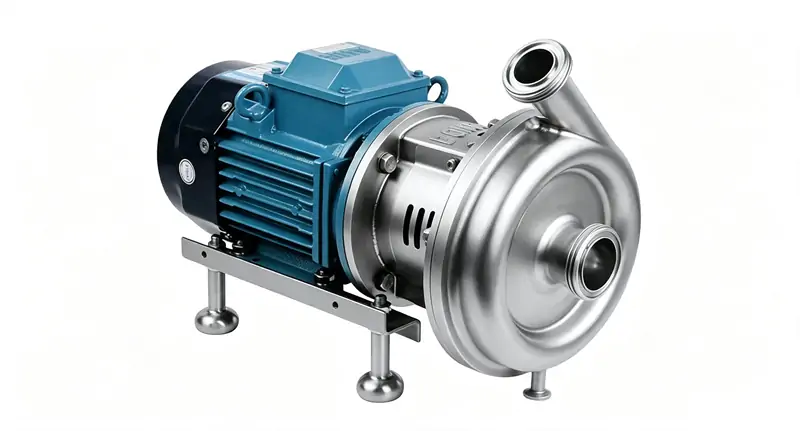
What NPSH Actually Means
NPSH exists in two forms: NPSH Available (NPSHa) and NPSH Required (NPSHr). The distinction between them is the foundation of proper pump selection.
NPSHa describes what the installation provides. It is a function of four factors: the absolute pressure on the surface of the liquid in the supply tank, the vertical distance between the liquid surface and the pump centerline, the friction losses in the suction piping, and the vapor pressure of the liquid at its pumping temperature. NPSHa is calculated, not measured on the pump itself. It belongs to the system, not the equipment.
NPSHr describes what the pump demands. It is determined by the pump's internal geometry—the impeller design, the inlet passage shape, and the rotational speed. NPSHr increases as flow rate increases, which is why the NPSHr curve on a pump performance chart rises with flow. NPSHr is measured by the manufacturer during testing and published as part of the pump curve.
The fundamental rule: NPSHa must exceed NPSHr by a safety margin. The Hydraulic Institute recommends a margin of at least 0.5 to 1 meter for most applications. When this margin is not met, the liquid pressure at the impeller eye drops below its vapor pressure, and cavitation begins.
How to Calculate NPSHa for a Sanitary Installation
The calculation follows a standard formula:
NPSHa = Ha ± Hs – Hf – Hvp
Where each term represents a specific physical factor:
Ha — Absolute pressure on the liquid surface. For an open tank at sea level, this is atmospheric pressure, approximately 10.33 meters of water column. For a pressurized vessel, the vessel pressure is converted to meters of liquid head. For a vacuum vessel, this term is reduced accordingly.
Hs — Static head. The vertical distance from the liquid surface to the pump centerline. If the liquid level is above the pump, Hs is positive and adds to NPSHa. If the pump must lift liquid from below, Hs is negative and subtracts from NPSHa. This is why flooded suction arrangements, where the supply tank is elevated above the pump inlet, are preferred for challenging applications.
Hf — Friction losses in the suction line. Every component between the tank and the pump—pipe, elbows, valves, strainers, heat exchangers—creates resistance that reduces the pressure available at the pump inlet. Friction losses increase with flow rate and with fluid viscosity. A strainer that gradually clogs during a production run will increase Hf and reduce NPSHa over time.
Hvp — Vapor pressure of the liquid. This is a function of temperature and the specific fluid being pumped. Water at 20°C has a vapor pressure of approximately 0.24 meters. The same water at 85°C—a typical CIP return temperature—has a vapor pressure of approximately 5.8 meters. The difference of over 5 meters of NPSHa can mean the difference between stable operation and severe cavitation, even though the pump and piping have not changed.
Why NPSH Matters More in Sanitary Applications
Sanitary processing presents specific NPSH challenges that are less common in industrial pumping:
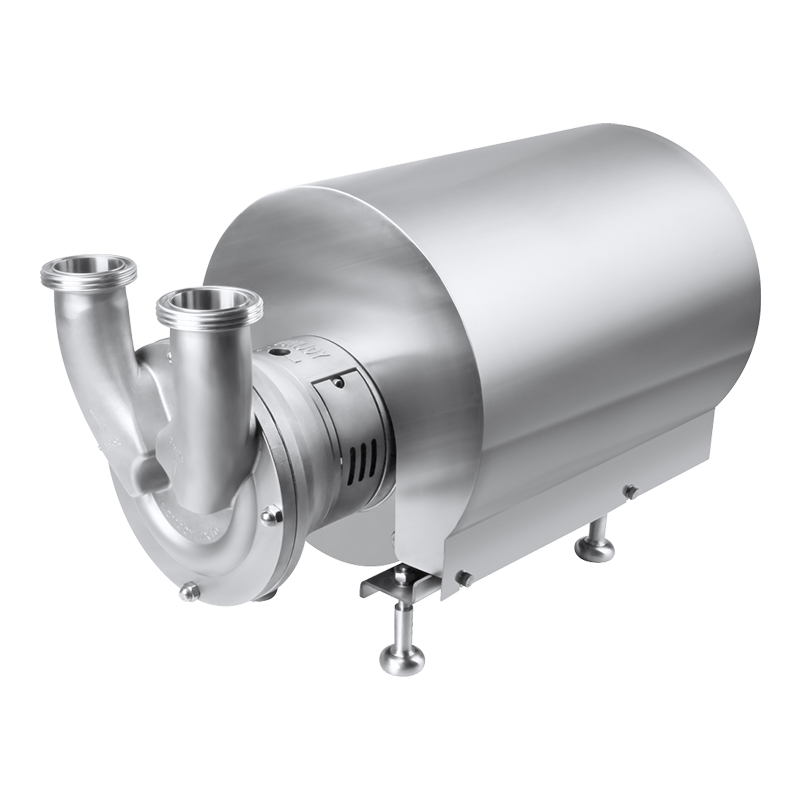
High-temperature CIP cycles. The same pump that transfers cold milk at 4°C must also circulate hot CIP solution at 85°C. The vapor pressure difference between these two conditions is dramatic. A pump selected with adequate NPSH margin for cold product may cavitate severely during CIP if the hot condition was not checked. When specifying equipment, verifying that sanitary stainless steel pump configurations can operate across the full temperature range of both production and cleaning cycles prevents this common oversight.
Viscosity changes between products. A pump on a multi-product line may handle water-thin beverages on one shift and viscous syrups or cream on the next. Higher viscosity increases friction losses in the suction line, reducing NPSHa. The pump must be specified for the most challenging product combination—highest temperature, highest viscosity, lowest tank level—that occurs during normal operation.
Product integrity and shear sensitivity. Cavitation does not only damage the pump. The collapse of vapor bubbles generates intense localized forces that can damage shear-sensitive products such as cultured dairy products, protein solutions, and biological fluids. In pharmaceutical and biotechnology applications, cavitation-induced product degradation can mean the loss of an entire batch.
Reading NPSH on the Pump Curve
A pump performance curve typically shows flow rate on the horizontal axis, head on the vertical axis, and NPSHr as a separate curve below the head curve. The NPSHr curve rises with flow rate—the pump demands more suction head as it moves more liquid.
To use the curve during selection, identify the design flow rate for the application. Find the corresponding NPSHr value from the curve. Calculate the NPSHa for the worst-case operating condition. Verify that NPSHa exceeds NPSHr by the safety margin across the full flow range the pump will operate in, not just the design point. A pump that runs at reduced flow during part of the batch or during CIP return must still maintain adequate margin at that condition.
Practical Steps to Ensure Adequate NPSH
Several design and operational choices improve NPSH margin:
Minimize suction lift. Where possible, locate the pump below the supply tank to create a flooded suction. Every meter of positive static head adds directly to NPSHa.
Size suction piping generously. Larger diameter pipes reduce friction losses. A suction line one size larger than the pump inlet connection, with a straight run of 5 to 10 pipe diameters before the inlet, reduces turbulence and improves NPSHa.
Keep suction strainers clean. A partially clogged strainer is one of the most common causes of NPSH-related cavitation in operating plants. Pressure gauges upstream and downstream of the strainer allow operators to monitor the pressure drop and schedule cleaning before the loss becomes critical.
Account for temperature in the specification. Calculate NPSHa at the highest expected fluid temperature, not at ambient conditions. The vapor pressure term changes significantly with temperature, and a calculation performed at room temperature may be misleading for a pump that handles hot CIP fluids.
For new installations or upgrades, selecting hygienic pumping equipment with documented NPSH curves across the full operating range provides the data needed to verify NPSH margin during the engineering phase rather than discovering a problem during commissioning.
From Specification to Reliable Operation
NPSH is not a pump specification that can be looked up in isolation. It is a relationship between the pump and the system that must be verified for each installation. The calculation is straightforward, but it requires accurate information about the suction piping layout, the fluid properties at all operating temperatures, and the worst-case tank level conditions. A pump selected with verified NPSH margin operates quietly, maintains its impeller condition over years of service, and protects the product from cavitation-induced damage.
Disclaimer
The NPSH calculation methods and guidelines in this article are for informational purposes based on general hydraulic principles and industry practice. Actual NPSH requirements vary with pump design, fluid properties, and system configuration. Always refer to the pump manufacturer's published NPSHr curves and consult with qualified engineering professionals when designing pumping systems for sanitary applications. Cavitation damage and performance issues resulting from inadequate NPSH margin are not covered by standard pump warranties.

 CN
CN EN
EN ES
ES RU
RU