Handling Soft Solids and Particles: Why Rotary Lobe Pumps Excel in Food and Beverage Processing
A pump that moves a smooth, homogeneous liquid like milk or clarified juice is performing the simplest task in food processing. The real challenge begins when the product contains soft solids—whole grapes in a wine must, diced tomatoes in pasta sauce, curds in cottage cheese, or strawberry pieces in yoghurt. These particles must be transported from one vessel to another without being crushed, without jamming the pump, and without the pump losing its ability to generate flow against the system's back‑pressure. A pump that fails on any of these counts will damage the product's texture, produce inconsistent fill weights, or stop the process line entirely.
Positive displacement pumps that rely on close‑fitting metal parts, such as gear pumps or progressing cavity pumps, often struggle with soft solids because the particles become trapped between the rotating elements and the housing. Centrifugal pumps, which depend on high‑speed impellers, can shear delicate particles and cause foaming or aeration. The design that has emerged as the standard solution for these applications is a positive displacement pump with non‑contacting, intermeshing lobes. A Rotary Lobe Pump transfers fluid by trapping a fixed volume between the lobes and the pump casing, without the lobes touching each other or the casing wall. This operating principle provides several advantages when the product contains soft solids.
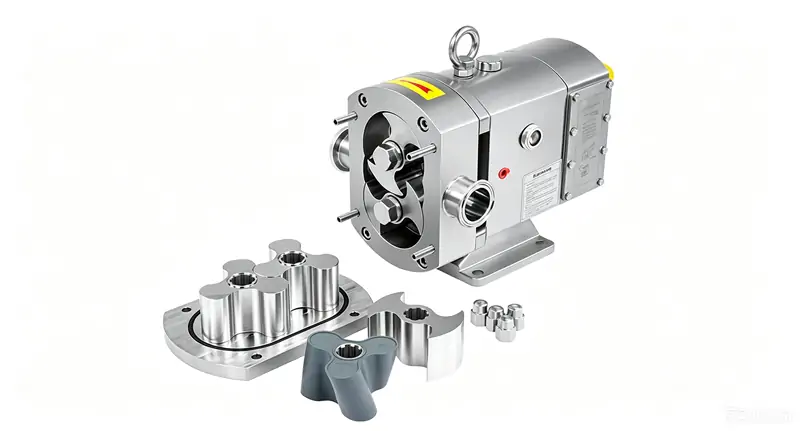
Large Clearances Between Lobes and Casing
The defining feature of a lobe pump for solid‑handling applications is the clearance between the rotating lobes and the pump housing. Unlike a gear pump, where the gears mesh tightly and shear anything caught between the teeth, the lobes in a rotary lobe pump run with a deliberate gap—typically several tenths of a millimetre—that is designed to be larger than the largest expected particle in the product. This gap allows soft solids to pass through the pump without being crushed or ground. A whole blueberry, a cooked bean, or a piece of diced carrot can move from the suction port to the discharge port essentially intact.
The clearance is set at the factory based on the application's particle size requirement. For products with larger particulates, pumps can be specified with enlarged clearances. The trade‑off is that a larger clearance allows more internal slip—fluid flowing backward from the discharge to the suction side—which slightly reduces volumetric efficiency. However, for food products where texture and appearance are critical, maintaining product integrity is worth the small loss in efficiency.
Low‑Shear, Gentle Product Handling
Because the lobes do not contact each other or the casing, the pump imparts very little shear to the product. The fluid is moved in discrete pockets from the inlet to the outlet, with minimal turbulence and no high‑speed impingement. This is essential for products that are shear‑sensitive, such as yoghurt with fruit pieces, cream cheese, or sauces with vegetable chunks. Excessive shear can break down the texture, release starch or pectin from the solids, and produce a watery or separated appearance in the finished package.
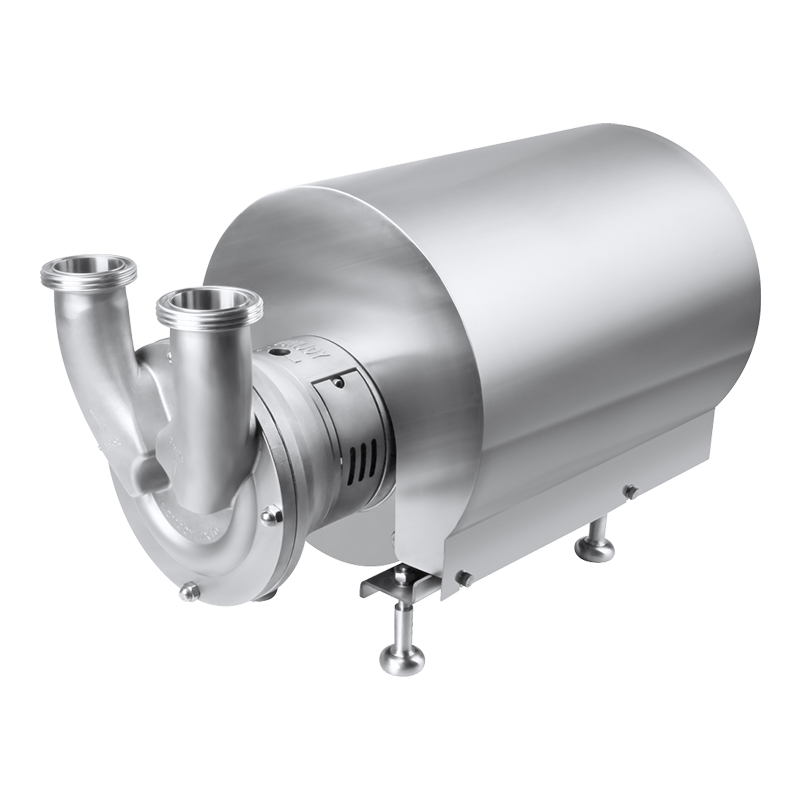
The low‑shear characteristic also applies during CIP cleaning. A lobe pump can be cleaned in place without disassembly, and the same low‑speed, high‑torque operating principle that protects product particles also allows cleaning solutions to circulate through the pump head without damaging the seals or the lobe surfaces. For processors who run multiple product types on the same line, this cleanability between batches is a significant operational advantage. Products that combine gentle handling with CIP compatibility, such as the Donjoy TU lobe pump series, are designed specifically for these demanding food applications.
Bi‑Directional Operation for Process Flexibility
A lobe pump can run in both directions, which is valuable in food processes where the flow direction needs to be reversed. A common example is the transfer of product from a mixing tank to a filler: the pump runs forward during the filling cycle and then can be reversed briefly to clear the line of product, reducing waste. During CIP, the pump can be reversed to ensure that cleaning solution contacts all surfaces of the pump head.
This bi‑directional capability also simplifies the pipework. A single pump can serve both as a transfer pump and as a return pump for CIP solution, eliminating the need for a separate CIP return pump and reducing the number of connections in the process line.
Comparison with Alternative Pump Types for Solids
| Pump Type |
Particle Handling |
Shear Level |
CIP Capability |
Best For |
| Centrifugal |
Poor—particles sheared by impeller |
High |
Good |
Homogeneous liquids |
| Progressing Cavity |
Moderate—particles can jam rotor/stator |
Low |
Limited |
Sludges and viscous fluids |
| Twin Screw |
Good—large clearances |
Low |
Good |
High‑pressure transfer of solids |
| Gear Pump |
Poor—gears mesh tightly, crush particles |
High |
Limited |
Clean oils and syrups |
| Rotary Lobe |
Excellent—non‑contacting lobes, large gaps |
Very Low |
Excellent |
Soft solids, fruit, vegetables, curds |
For the middle column—where particle integrity and CIP cleanability are both required—the lobe pump is the preferred choice. This is why it appears so frequently in dairy, prepared foods, beverage, and confectionery plants.
A Note on Pressure and Speed
When pumping products with soft solids, the pump speed should be kept at the lower end of its operating range. A slower speed reduces the velocity of the fluid through the pump head, giving particles more time to pass through the lobe gaps without being damaged. It also reduces the internal slip flow, which can become significant at low viscosities and high pressures.
The maximum differential pressure rating of the pump—typically up to 15 bar for sanitary models—should not be approached when the product contains soft solids. Running at lower pressure reduces the mechanical stress on the particles and extends the life of the lobes and the shaft seals. Most food applications with soft solids operate at well below 10 bar differential pressure.
Selecting the Right Pump for Your Solid‑Handling Application
When specifying a lobe pump for a product that contains soft solids, the following parameters should be provided to the pump manufacturer: the type, size, and concentration of the solids; the carrier fluid viscosity; the required flow rate; and the system's discharge pressure. With this information, the manufacturer can recommend the correct pump size, lobe clearance, and operating speed. A TU series lobe pump configured for soft solid transfer will deliver consistent flow, preserve product texture, and clean reliably between batches.
A pump that handles soft solids without damaging them is not a luxury in food processing—it is a requirement for product quality and customer satisfaction. The rotary lobe pump has earned its place as the standard solution for this task because its non‑contacting design, large clearances, and low‑shear operation deliver exactly what food manufacturers need: product that reaches the package looking and tasting the way it did when it left the preparation tank.

 CN
CN EN
EN ES
ES RU
RU