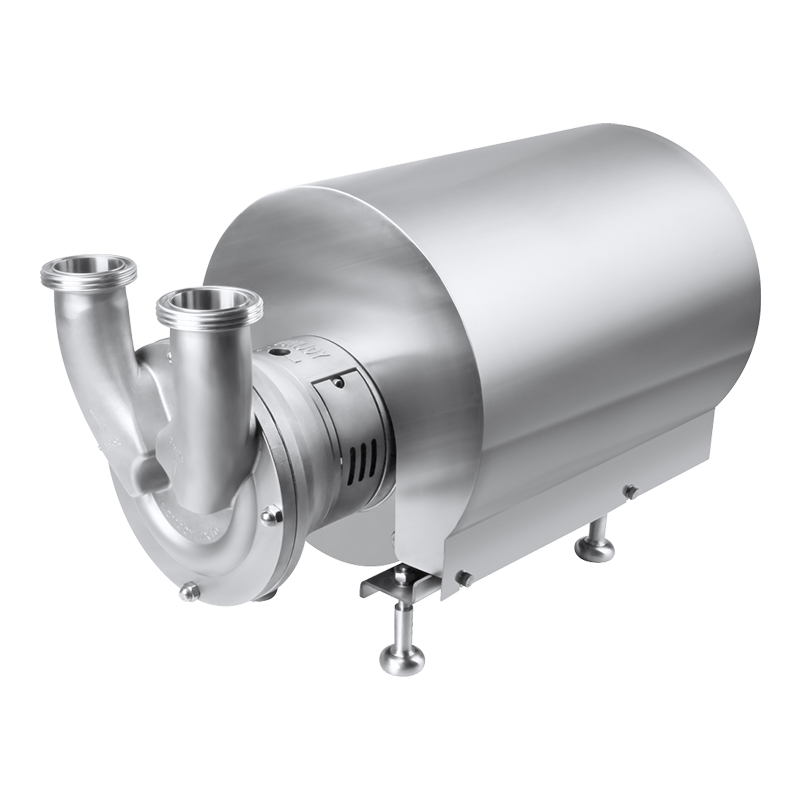
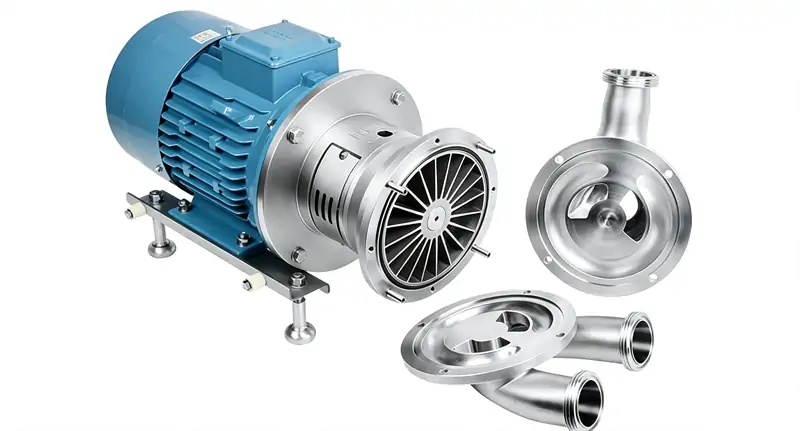
When evaluating pump options for hygienic applications, suction capacity often becomes the deciding factor between smooth operation and persistent process interruptions. A pump's ability to handle suction lift—drawing liquid from a source below its centerline—depends on a combination of system conditions, fluid characteristics, and pump design. For applications requiring reliable self-priming capability without external priming devices, a sanitary self-priming pump offers an integrated solution that simplifies system layout and reduces auxiliary equipment. Understanding these variables helps engineers avoid cavitation, maintain product integrity, and ensure consistent flow rates across production cycles.
The NPSH Balance: What the System Provides vs. What the Pump Requires
Net Positive Suction Head (NPSH) forms the foundation of suction analysis. NPSH Available (NPSHa) represents what the installation delivers—a function of atmospheric pressure, static head, fluid vapour pressure, and friction losses in the suction line. NPSH Required (NPSHr) is what the pump demands at a given flow rate, determined by its internal geometry and operating speed.
The fundamental rule: NPSHa must exceed NPSHr with a safety margin, typically 0.5 to 1 meter according to Hydraulic Institute standards. When this margin erodes—due to a partially clogged strainer, elevated product temperature, or extended suction piping—cavitation follows. Vapour bubbles form and collapse at the impeller surface, causing pitting damage, vibration, and reduced performance.
Calculating NPSHa requires accounting for all losses in the suction path. A plant running a short transfer line at ambient temperature may have ample margin, while the same pump struggling with warm CIP return fluids at the end of a long piping run could fall into cavitation territory. The system, not just the pump, determines success.
Fluid Properties Shape the Suction Strategy
The liquid itself dictates suction requirements. Three properties dominate:
Viscosity increases friction losses dramatically. Heavy creams, sugar syrups, or concentrated purees require slower pump speeds and oversized suction lines to prevent the pump from essentially pulling a vacuum against its own supply. Pumps with properly matched clearances and operating speed handle these thick products without cavitation.
Vapour pressure rises with temperature. CIP solutions at 85°C have significantly higher vapour pressure than cold product, reducing NPSHa precisely when cleaning demands reliable flow. Pumps specified only for cold duty may fail during sanitation cycles if this thermal factor was overlooked.
Entrained air complicates priming. Tank stripping operations, mixer agitation, and product returns all introduce gas into the liquid stream. A pump handling two-phase flow must re-establish prime without manual intervention, a capability that varies considerably across designs. Engineers working with challenging suction conditions often look for equipment with high-suction sanitary design features to address these operational demands.
Inlet Piping: Where Good Pump Selections Fail
Even a carefully specified pump underperforms when connected incorrectly. The inlet piping immediately upstream controls flow symmetry entering the impeller.
An eccentric reducer at the pump suction—installed with the flat side up—prevents air accumulation at the high point of the pipe. A concentric reducer, by contrast, traps vapour pockets that periodically break loose into the pump, causing sudden loss of prime. This single fitting choice can mean the difference between stable operation and intermittent cavitation.
Beyond reducers, a straight pipe run of 5 to 10 diameters upstream of the suction flange allows flow to develop a uniform velocity profile. Elbows, tees, or valves placed too close create asymmetric flow that starves one side of the impeller, generating localised cavitation even when NPSHa calculations show adequate margin.
Cleanability and Long-Term Suction Reliability
In food, beverage, or pharmaceutical service, cleanability directly affects suction performance over time. Product residue accumulating on seal faces creates leak paths. Surface roughness harbours biofilms that increase friction losses in repeated cycles.
Equipment with full CIP compatibility, 316L stainless steel wetted parts, and surface finishes meeting 3-A or EHEDG standards addresses these risks at the design level. Internal contours that drain completely, mechanical seals flushed to prevent product hang-up, and absence of dead zones where fluids stagnate all preserve suction capability across thousands of batches.
Matching Suction Capacity to Your Process
Selection starts with mapping worst-case conditions: the highest temperature, longest suction line, and most viscous product your process will encounter. Calculate NPSHa at that extreme, compare against pump curves showing NPSHr, and maintain your safety margin. Then verify inlet piping configuration meets straight-run and reducer requirements.
System details—piping layout, fluid data, cleaning protocols—ultimately determine whether the selected pump delivers reliable suction performance under real operating conditions. For those specifying equipment in hygienic industries, reviewing sanitary pump configurations engineered for suction lift provides a starting point to compare designs against your calculated requirements.

 CN
CN EN
EN ES
ES RU
RU